Parents cannot predict the future, but they can help children meet it. That means learning and relearning, checking AI answers, directing attention, creating, cooperating, considering consequences and keeping the right to decide what matters.
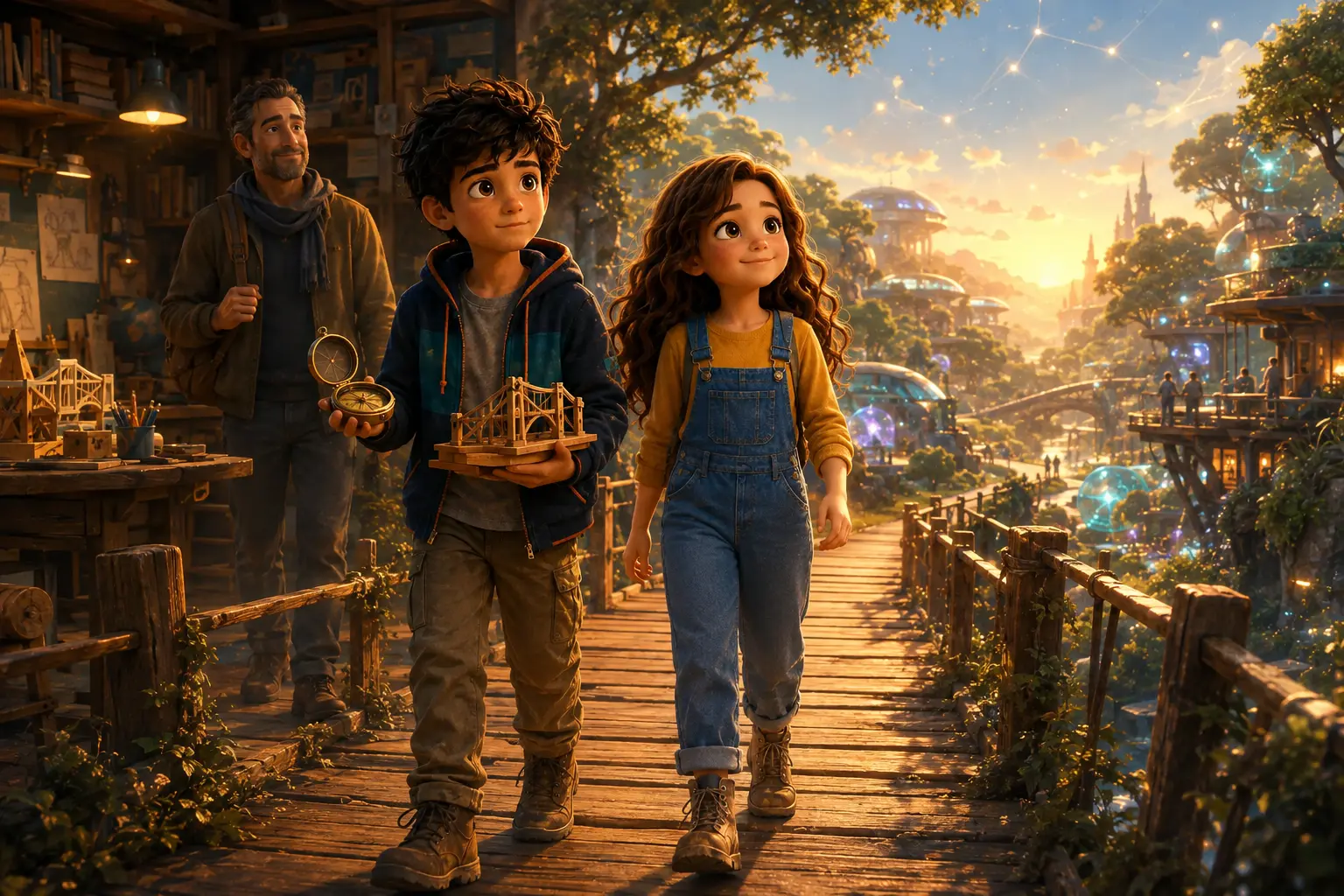
Imagine a child who is ten today. In five years they will be fifteen. In eight, they may be choosing further education, a profession, a first job or a path of their own. Parents usually think about that future much as they thought about their own: do well at school, gain an in-demand qualification, learn a profession, build knowledge and experience, and become good at your work. For decades, that model seemed reasonable.
But a child who is nine to twelve today may enter adulthood in a world where that sequence already looks outdated. Not because education will disappear, but because we may answer an important question differently:
Why should a person learn when an intelligence beside them knows more, learns faster and can do much of the intellectual work?
That question is no longer merely science fiction. It is one reason today's nine- to twelve-year-olds may be a distinctive generation.
A generation in transition.
First, a forecast that frightens many people
In 2025, researcher and forecaster Daniel Kokotajlo and colleagues published a scenario called “AI 2027”. It explores a possible path in which, within the next few years, AI becomes able to automate much of AI research itself. An accelerating effect follows: stronger AI helps create still stronger AI, and technological development speeds up sharply. In the original scenario, the authors considered the possibility of superhuman AI systems emerging around 2027–2028.
It is essential not to turn a scenario into a prophecy. The authors themselves stressed the great uncertainty in their forecasts. They later explained that the year 2027 never meant they were certain AGI would arrive then. By early 2026, Kokotajlo's own median estimate had moved to around 2030. That is an honest part of the conversation. We do not know whether human-level or superhuman AI will appear in 2027, 2030, 2035 or much later.
But another fact matters more to parents than an argument over the date. A child who is ten today will grow up during the period in which this question may be settled. And the costs of being wrong are uneven. If radical change takes twenty years, independence, adaptability, critical thinking and the ability to work with AI will still be useful. If it comes in five to seven years, preparing a child only for the world of our own childhood will be too late.
We can already see the transition beginning
You do not have to believe in superintelligence to notice what is happening. According to the Stanford AI Index 2026, four in five American high-school and college students already use AI in their schoolwork. Education systems are visibly lagging behind: only around half of middle and high schools have AI-use policies, and only a small proportion of teachers find those policies clear. Changes have also begun in the economy. The Stanford AI Index reports rapid adoption of generative AI by organisations and the first noticeable labour-market changes, particularly among young professionals in some knowledge-based occupations. The authors also stress that AI has not yet caused widespread unemployment and that its effects vary substantially by occupation and task.
Research by Anthropic in 2026 also points to uncertainty. AI users expect systems to be capable of doing a large share of their work within a year, yet experienced professionals especially often identify human judgement, context, trust and relationships as difficult to hand over to a machine. The study's sample consisted of Claude users and was weighted towards technology and management occupations, so it would be wrong to turn its results into a forecast for the whole economy.
We do not yet live in the world described by “AI 2027”. But we already live in one where the old foundations of education have begun to shift.
The uncomfortable question: why should a child know what AI knows better?
Parents born in the 1980s and 1990s grew up when information was fundamentally scarce. To learn something, you had to find a book, ask a teacher, go to a library, memorise and study. Keeping knowledge in your head had enormous practical value. Our children face a different reality. They can ask AI:
“Explain this topic as if I were ten.”
“Now explain it using football.”
“I still don't understand the third point. Explain it another way.”
“Check whether my reasoning is correct.”
“Create five exercises focused on the things I get wrong.”
“Look at my answers and tell me what I don't understand.”
This is more than a search engine. Potentially it is a personal teacher, conversation partner, translator, editor, programmer, researcher and assistant available to every child. A school built primarily around passing information from someone who knows to someone who does not therefore faces a fundamental question about its role. That does not mean knowledge is unnecessary.
On the contrary, without their own understanding of the world, people cannot properly assess what a machine tells them. But the function of knowledge is changing. Previously an advantage often lay in knowing the answer. Increasingly, it may lie in the ability to:
understand an answer, check it, connect it to reality, recognise its limits and decide what to do with it.
Homework is beginning to lose its old meaning too
Imagine an ordinary school assignment:
“Write an essay about...”
What is it meant to assess: a child's ability to understand a text, express ideas, build an argument or write accurately? If AI can produce a better essay than the average school essay in seconds, having a finished text no longer proves that the child has those abilities. The same is happening with presentations, reports, translations, some coding, information searches and many routine problems.
We can ban AI. We can try to detect its use. But as the technology improves, this may increasingly resemble a school's fight against calculators, the internet or computers. A more interesting question is:
What assignment makes sense if we assume a powerful AI will always be available to the child?
Here education begins to change in substance. Not:
“Do it without AI.”
But:
“Show what you understand.”
“Explain why you agree with the AI's answer.”
“Find its mistake.”
“Suggest a better question.”
“Compare several solutions.”
“Test the answer in the real world.”
“Create something that was not in the original task.”
“Explain your own choice.”
Education begins to shift from producing a correct answer to developing the thinking of the person who uses it.
What if AI is smarter than most adults in five years?
This is an uncomfortable thought experiment, but worth trying. Imagine a considerably more moderate version of “AI 2027”. AI does not yet run the world, possess absolute intelligence or replace people everywhere. But it can already perform many everyday tasks as well as a good programmer, analyst, translator, marketer, designer, tutor, medical assistant, researcher or adviser.
One person working with several AI agents can do what once required several specialists. I am not claiming that 2031 will necessarily look like this. But it is plausible enough to prompt a question:
What should we teach a ten-year-old today for such a world?
Much changes when we ask that.
A profession becomes a less reliable unit of planning
For earlier generations, “What do you want to be?” had a clear meaning: a doctor, lawyer, programmer, economist or architect. A profession was a relatively stable set of knowledge and activities that could be learned and refined over years. With rapidly developing AI, it is more reasonable to assume that the makeup of many professions will keep changing. Doctors will not necessarily disappear, but their work will change. Architects will not necessarily disappear.
But the way they work will change. Entrepreneurs will not necessarily disappear. But one entrepreneur may be able to do what once required a team. Programming will not necessarily disappear. But a person manually writing every line of code and a person who understands a system, defines the task and directs an array of AI tools may be valued differently. So the question:
“Which profession should my child choose?”
may gradually give way to another:
“What kind of person do they need to become to remain valuable in a constantly changing world?”
This is where the real problem in today's education begins
Many schools still reflect a relatively stable world. There is a curriculum, a prescribed body of knowledge, a common pace, assignments, correct answers, marks, an adult who knows and a child who must learn. But if the outside world changes faster than the curriculum, something strange happens. We can prepare a child very well for an exam based on a model of a world that may no longer exist by the time they grow up.
This is where schooling risks becoming absurd, not because children no longer need knowledge, but because we may confuse knowledge with the purpose of education. Knowing multiplication tables is useful. Understanding history is essential. Reading a difficult text matters. Mathematical thinking is valuable. But the ultimate aim can no longer be merely accumulating as many correct answers as possible. When correct answers become cheap, the person able to use them becomes valuable.
A new educational task: do not compete with AI
This may be the most important thought for a parent. We do not need to prepare children to compete with artificial intelligence. If machines become better at remembering, calculating, searching, coding or analysing enormous amounts of information, it makes little sense to make beating them at those things the main goal of education. Chess players have long lived in a world where computers play better than any human. Chess has not disappeared.
The roles of machine and person have changed. So the question is not:
“What can a person do better than AI?”
That list may keep shrinking. A more enduring question is:
“What does a person want to do with the intelligence available to them?”
This unexpectedly brings us back to things technological progress does not make less important: values, responsibility, choice, understanding consequences, relationships, meaning, will, curiosity, independence, the ability to bear uncertainty and to set our own goals.
The biggest risk may not be that the machine becomes too smart
There is a more immediate risk.
A child may stop developing their own abilities because they learn too early to hand every difficult task to a machine.
Don't understand a text? Let AI summarise it. Need an idea? Let it invent one. Need to write? Let it write. Need a decision? Ask AI. Need to understand? Ask for a short answer. The route is tempting. But part of human development happens in the space between:
“I can't do this yet” and “I gradually worked it out.”
That is where we practise paying attention, make connections of our own and develop patience. We learn to tolerate confusion, encounter mistakes and change strategy. Parents of the generation in transition will need to master a new educational task:
not shielding a child from AI, but teaching them to use AI in ways that strengthen rather than replace their thinking.
A child needs AI to support their thinking, not replace it
Imagine two ways to use the same technology. The first child says:
“Do it for me.”
The second:
“Help me understand.”
The first:
“Write the answer.”
The second:
“Check my reasoning and show me the weak point.”
The first:
“Solve the problem.”
The second:
“Don't tell me the answer. Give me a hint.”
The first hands the activity itself to AI. The second uses AI to extend their own activity. After several years the difference could be enormous. Future AI literacy will therefore involve more than writing good prompts. It includes a harder question:
“What is worth handing to the machine, and what is important for me to do myself?”
A second risk: receiving answers before learning to ask questions
When almost any answer is instantly available, the value of a question changes. A good question becomes more valuable. What am I trying to understand? Why do I believe this? What assumptions are hidden in the answer? What is fact and what is interpretation? What information is missing? Who benefits from this explanation? What changes if the initial assumption is wrong? How can I check? When information was scarce, the person who found an answer had an advantage.
In a world overflowing with answers, a major advantage belongs to someone who can understand which question is worth asking in the first place.
A third risk: losing touch with what you want
This is a deeper problem. Imagine AI that knows a child's preferences and recommends music, films, games, books, people, routes, purchases and ways to learn, and eventually professions, decisions, projects and ideas. The better the system understands someone, the more convenient its recommendations. But a strange question arises:
If I am constantly told what I should like, will I learn to understand what I want?
A strong sense of self becomes not just an attractive psychological concept but a practical need in a technological age. A child will need to ask:
“Am I really interested in this?”
“Why do I want it?”
“Is this my choice, or one offered to me?”
“What matters to me when nobody is giving me a mark or a recommendation?”
A fourth risk: the world may change faster than people can adapt
The defining feeling of the coming years may be not technological wonder, but acceleration. New tools. New professions. Familiar functions disappearing. New rules, ways to learn, opportunities and threats. What someone learned two years ago may no longer be the best way to work. This world will be especially difficult for someone who needs things to stay the same in order to feel safe.
A child growing up during this transition therefore needs more than the ability to adapt well once. They need adaptability as an ongoing capacity. Not:
“I've finally understood how the world works.”
But:
“I understand that the world will keep changing, and I can learn as it changes.”
What, then, remains a human task?
We cannot make a final list today, and must admit that honestly. AI may learn much that we now consider uniquely human: creating, persuading, designing, diagnosing, researching, teaching and managing. It is risky to base education only on “a machine will certainly never be able to do this”. But there is another level. Even if AI can offer a hundred solutions, a question remains:
Which one should we choose?
If it can create a thousand projects:
Which are worth bringing to life?
If it can explain consequences:
Which consequences do we consider acceptable?
If it can expand human capabilities:
What should we use that power for?
Technology increases our ability to act. But it does not by itself answer a person's question:
What are we acting for?
The more powerful the tool, the more important the person who sets its direction.
Education for the future does not begin with technology
Here is a paradox. The stronger AI becomes, the more important it is to prepare a child in ways that go beyond technology. They need the ability to learn, responsibility, resilience, self-reflection, empathy, the ability to see reality rather than only a desired picture, self-regulation, inner stability and an understanding that personal decisions exist within society and affect other people.
Not because “AI will never imitate these qualities”. We do not know that. But because people will have to live with the consequences of their own choices. Here education meets life again.
Perhaps the unit of education will be a task, not a subject
Imagine a child receiving not only separate maths, language, history and computing lessons, but a real task. For example:
“How can we reduce food waste at your school?”
To solve it, they must count, gather data, talk to people, check sources, use AI, form hypotheses, make mistakes, change solutions, explain ideas, reach agreements and assess consequences. Knowledge from different fields becomes a tool for action. The child understands much more clearly why maths, language, technology or history matters. I am not claiming every school will work this way in five years.
But the direction seems important. If AI can provide knowledge instantly, human learning may naturally move further towards application, exploration, creation and reflection.
Teachers do not disappear. Their role changes
If AI can explain a subject to each child, patiently and in different ways, it becomes harder for a teacher to remain the main transmitter of information. But that does not make a good teacher unnecessary. On the contrary, it opens space for more human work: seeing the child, noticing where they avoid difficulty, organising shared activity, creating intellectual challenges and helping them encounter different perspectives.
Helping a conflict of ideas remain separate from a conflict between people. Helping distinguish one's own thought from a beautifully worded machine answer. Asking a question the child has not yet asked. A teacher may become less a source of answers and more an architect of experience.
What can parents do now?
Do not wait for education reform. This may be the most practical conclusion. School is a large system, and large systems change slowly. A family can begin today. There is no need to cancel school education, remove a child from school because AI exists or urgently turn a ten-year-old into a programmer. We can gradually change the family understanding of what “well prepared for the future” means.
It is not the child who masters a particular tool first. In a few years that tool may be obsolete. Better prepared is a child who can meet a new tool and quickly understand what it can do, where it makes mistakes, how to use it, when to trust it, when to check it, what to hand over, what to keep for themselves and why to use it at all.
Explore AI together instead of simply banning it
One of the best gifts a parent can give a child in the generation in transition is to stop seeing AI only as a danger or a way to cheat. Explore it together. Ask several systems the same question. Find an error. Ask for an explanation, then check it against other sources. Ask AI for arguments on opposite sides and discuss which is more convincing and why.
Let the child solve a problem first, then compare their solution with the machine's. Ask:
“What did AI see better than you did?”
Then:
“What did you notice that it missed?”
This matters more than a formal lesson on “how to use AI”. The child learns to relate to a new kind of intelligence. Not worship it. Not fear it. Not surrender their judgement to it, but learn to work with it.
Give children room to create
If AI makes content production almost free, initiative becomes especially valuable. Not only:
“Complete the assignment.”
But:
“What do you want to make?”
Invent a game. Make a short film. Write a story. Start a school project. Conduct research. Organise an event. Try earning first money. Solve a problem for the family or neighbourhood. Today, with AI, a child can potentially access tools once available to an adult team. That is an extraordinary opportunity. But it means nothing without a personal impulse:
“I want to create this.”
Future creativity therefore begins not with mastery of a tool, but with authorship.
Help a child live without a ready-made script
This is one of the hardest tasks for parents. We grew up with a relatively clear sequence: school, university, work, career, home, family, promotion. Real life was never that simple, of course, but a cultural script existed. For our children it may be much weaker. They may have to change fields several times and create work that did not exist before.
Work with AI agents. Learn throughout life. Rebuild their sense of identity. Live in a world where a “profession for life” finally becomes the exception. Then a crucial ability is one a test can hardly measure:
the ability not to fall apart when the next chapter of life has not yet been written.
Radical trust in life matters especially here
Parents face a transition too. We cannot give a child an accurate map of the world in 2031. We do not have one. We cannot name nine professions guaranteed to be in demand. We cannot explain in advance how schools will work. We do not know which current skills will rapidly lose value or which will unexpectedly become important. We can see uncertainty as a catastrophe. Or we can see a deep lesson in it.
Our task was never to write a child's life in advance.
It is to help them become someone able to meet life for themselves. Radical trust in life in the age of AI might sound like this:
“I don't know what the world will be like when you grow up. But I can help you learn to see reality, learn from it, make choices and transform your experience. Then you will not need me to have guessed the entire future.”
A generation in transition
Children aged 9 to 12 today may have an unusual historical role. They were born into a world where education, work and human intelligence were still viewed much as they had been for decades. But they may grow up in a very different reality. They are old enough to remember a world before AI agents became widespread, and young enough to build most of their lives after their arrival.
Perhaps this is why they can be called a generation in transition. Such a generation has both a difficulty and an advantage: it must give up some old bearings, but can help create new ones.
What would I give a ten-year-old if the world really changes in five years?
Not a profession. We do not know what it will be. Not a set of correct answers. There will be more answers around them than ever. Not certainty that everything will be fine. We cannot promise that. I would want to give them something else: the ability not to fear saying:
“I don't know.”
Because what follows is:
“But I can work it out.”
The ability after a mistake not to say:
“I'm incapable.”
But to ask:
“What do I know now?”
The ability to meet change not only with:
“Why isn't everything the way it used to be?”
But also:
“What is possible now?”
The ability to use machine intelligence without giving it the right to determine one's life. To understand others and build relationships. To choose not only what is efficient, but what matters. To know why one acts. And, in a world parents could not foresee, not to wait for ready-made instructions.
Perhaps the real purpose of education is becoming clear now
For decades we could afford to confuse education with the transfer of knowledge because knowledge was expensive. Now knowledge, answers, text, code, analysis and even some intellectual work are rapidly becoming cheaper. Against that background, what was always more important comes into clearer view.
Education should help a person become capable of directing their own life.
To understand, choose, act, see consequences, reconsider decisions, learn, create, cooperate, maintain inner stability, use increasingly powerful tools and never lose the question:
“What for?”
If the rapid-AI scenario proves wrong and major change takes much more than five years, we will have lost almost nothing by raising children this way. But if it is even approximately right, these qualities may become far more important than many things occupying much of today's school day. So perhaps the main question for parents of the generation in transition is no longer:
“How can we prepare a child for the future?”
None of us knows the future well enough. A stronger question is:
“How can we help a child become someone who can face an unknown future, not lose themselves and learn from the life they are given?”
Perhaps this is what we need to begin teaching children now.
From reading to experience
Explore a situation together
Talk about what happened, the choices available and what each choice might lead to. It is a chance to think together and hear each other's point of view.
Reflect on your relationship
What is your child learning alongside you?
Explore your everyday responses and discover areas you may want to pay closer attention to.
Explore the parent reflection →Almost finishedWhen you reach the end, this article will be marked as read on this device.
Share this article
Share an idea with other parents
Choose a way to share or copy the link.