
AI ends the school’s monopoly on explanation, but does not make teachers unnecessary. Their role increasingly includes creating experiences in which children think, choose, make mistakes, cooperate, test answers against reality and learn to direct themselves.
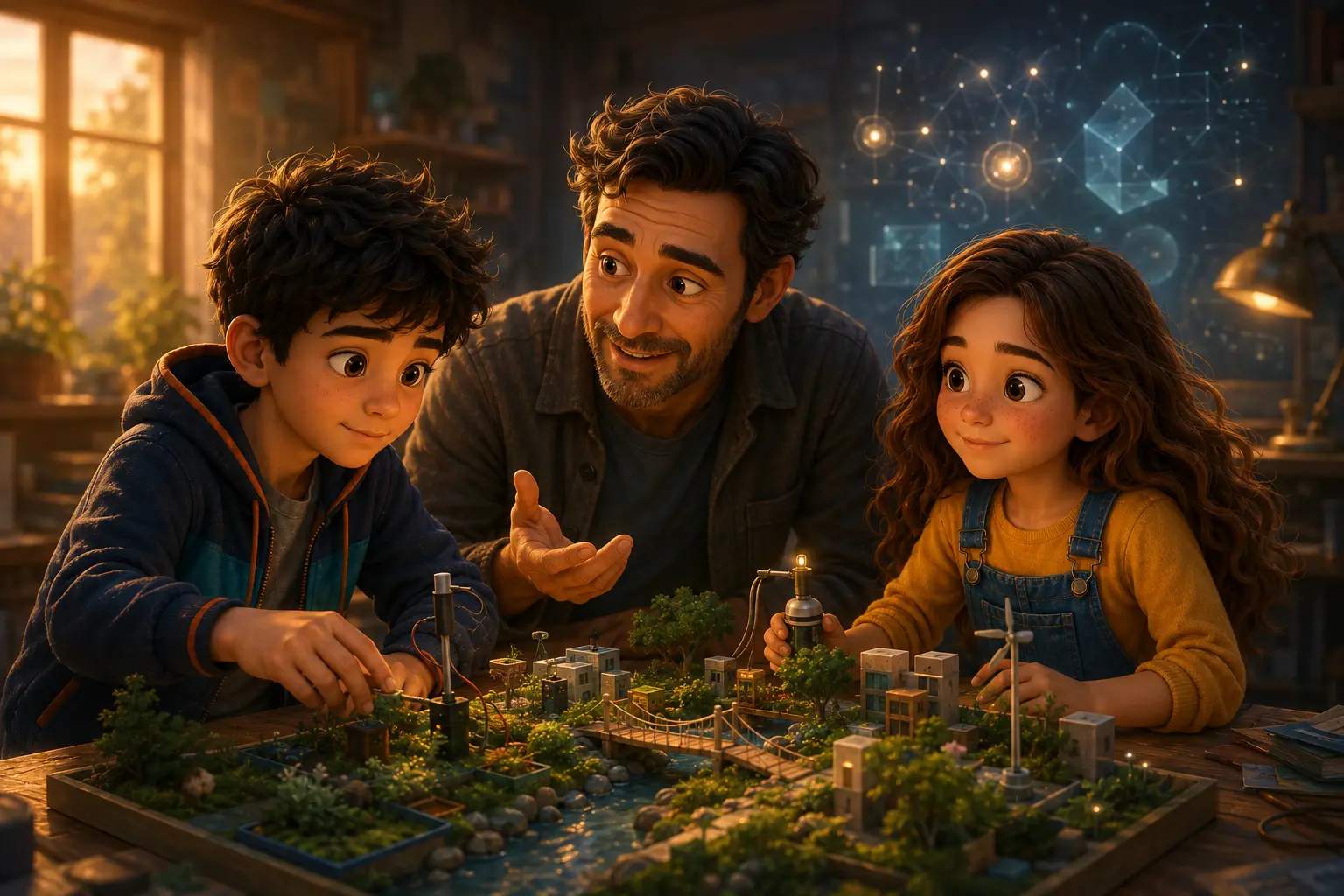
A message to those guiding a new generation into a new era
Dear teacher, your profession may never before have stood at such an unusual point. On one hand, artificial intelligence is beginning to do things that have made up much of education for centuries: explain, answer questions, check writing, translate, prepare exercises, find information, create presentations and help solve problems. On the other, a teacher may now become more important to a child than ever.
But in a very different role. Not as the person who knows the answers, but as someone who helps a child learn to live in a world full of answers. This is an enormous change, and perhaps one of the most important transformations of teaching in the history of mass education.
We must recognise that the old educational bargain is ending
For a long time, school was built around a scarcity of knowledge. Knowledge was held by the teacher, textbook, library and university. The child's task was to acquire, remember, reproduce and learn to apply it. That system made sense in its time. But a child sitting in class today can already open a device and receive an explanation of almost any school topic in seconds. More than one explanation, in fact.
If they do not understand, AI can explain more simply, in greater detail, with another example, taking their mistakes into account and repeating as often as necessary. UNESCO already describes the new educational reality not merely as a teacher–student relationship, but as an interaction between teacher, AI and student, stressing that this change requires the teacher's role itself to be reconsidered. This does not mean the end of teachers. But it does mean the end of their monopoly on explanation.
Fighting to retain that monopoly is pointless.
A teacher no longer has to be the most knowledgeable intelligence in the classroom
That may sound provocative. But let us look without fear. If a child has access to a system that knows more than any individual person, does the teacher become unnecessary? Only if we believe a teacher's main job was to know more than the pupil. A real teacher has always done much more. They noticed when a child seemed to answer correctly but understood nothing.
They saw fear behind challenging behaviour. Sensed when to help and when not to intervene. Created interest. Stopped humiliation. Brought children together as a team. Asked a question that suddenly made someone think differently. Sometimes believed in a child before the child believed in themselves. None of these actions can be reduced to transferring information. And this part of the profession is now coming to the fore.
Not a source of knowledge, but an architect of experience
In a new kind of school, teachers may spend less time asking:
“How do I pass on the content?”
And more time asking:
“What experience will help this child develop understanding?”
This is a fundamentally different approach to teaching. We can tell children about conflict, or create a situation in which they must reach an agreement. We can lecture about responsibility, or offer a shared project in which one person's actions really affect others. We can explain critical thinking, or give students three convincingly written AI answers, one containing an error, and ask what can be trusted.
We can talk about civic responsibility, or help children see a real problem in their school or neighbourhood and try to change something. Knowledge does not disappear. But it stops being education's final product and becomes a tool for action. Rather than merely passing on content, the teacher designs conditions in which children think, choose, make mistakes, engage with reality and reflect on results.
This is what I mean by a teacher as an architect of experience.
Fewer ready-made answers. Help children manage without them
This sounds almost paradoxical in a profession linked with explanation for centuries. But the more accessible answers become, the more important it is to act where no correct answer is known in advance. Whom should I support in a conflict? Keep trying or stop? Should I trust someone? What if an efficient solution feels wrong? What if AI suggests one option, parents another, friends a third, and the child feels differently?
Which goal should I choose when hundreds are possible? These are not exercises with an answer at the back of a textbook. Much of today's children's adult lives will consist of questions like these. We need children who do not freeze before the unknown, waiting for:
“Tell me the right answer.”
They can pause, see the situation, gather information, consider options and consequences, check against their values, make a choice and be ready to change it if reality shows they missed something. That is what a school of the future should teach.
A correct answer no longer proves learning has happened
This is already a practical problem. A child can bring an excellent essay they did not write, create a presentation on a subject they barely understand or obtain the right solution without understanding the reasoning. Research summarised by the OECD in 2026 points to this problem: using general-purpose generative AI can improve task performance without a corresponding improvement in understanding. When much of the thinking is handed to a machine, a good final product does not itself mean the student has learned.
Assessment must therefore change too. It is no longer enough to ask only:
“What was the result?”
It becomes more important to ask: How did you reach it? Why did you choose that source? What did AI do, and what did you do? Where did you disagree with it? Which options did you discard? Where was the mistake? What changed after feedback? What can you now do without help? We need to assess more than the product and pay attention to the child's thinking and development.
Mistakes must stop being treated like school crimes
A school cannot tell children they will live in a world of innovation while punishing every incorrect attempt. Creating something new involves uncertainty. Uncertainty involves hypotheses. Hypotheses involve the possibility of error. If a child spends most of school practising above all not making mistakes, we may produce a convenient pupil for the old system and a person poorly prepared for the new one.
The teacher's task must change: not to eliminate error, but to teach children to work with it. Where did your model differ from reality? What did the result show? Which assumption was wrong? What might you try now? A mistake then stops being a red mark at the end of an action and becomes part of learning itself.
We must return responsibility for education to the child
Modern schooling is often arranged strangely. Adults decide what a child will learn, when, for how long, by what method, which task they will complete, what the result should look like, when it will be checked and how it will be graded. Then we wonder:
“Why don't children want to learn independently?”
But independence does not arise from years of following other people's instructions. To become an active owner of their education, a person must gradually gain influence over it: choose an approach, ask their own questions, propose projects, challenge a decision with reasons, seek sources, set some goals, plan work, face consequences and ask for help when genuinely needed.
The OECD already frames education's future more broadly than the introduction of individual AI tools: change may be so rapid that it requires reconsidering competencies, curricula and how educational experience is organised. We cannot prepare a child for independence without giving them a chance to be independent.
Teachers must stop fearing “I don't know”
The old professional model carried a heavy hidden burden. The teacher must know. The student asks; the teacher answers. But in a world changing faster than textbooks, that arrangement becomes impossible. A student may bring a technology the teacher has not used, ask a question nobody in the room can answer or show an AI result that needs checking together. One of the strongest phrases a teacher of the future can say is:
“I don't know. Let's find out.”
This is not a loss of authority. It demonstrates how an adult engages with uncertainty: searches, doubts, checks, admits error and changes their mind when new evidence appears. The teacher shows more than knowledge. They show how to learn. That may become one of the central professional skills of a teacher in the new era.
Teachers will need to become learners again too
We cannot accompany children into a rapidly changing world while staying outside it. A teacher need not become a programmer or machine-learning specialist. But AI should gradually become part of their professional literacy, and not merely as a faster way to prepare lesson notes. Teachers need to understand what systems can actually do, where they err, how children use them, when AI strengthens learning and when it replaces it, the ethical issues, changing authorship, reliability, privacy and which assignments have lost their former educational value.
UNESCO already offers a framework of fifteen AI competencies for teachers, covering a human-centred approach, AI ethics, understanding technology, AI pedagogy and continuing professional learning.
The existence of such a framework shows the scale of change. We can no longer treat AI as an optional topic for computing teachers. It is becoming part of the environment in which education happens.
AI should not replace teachers. It should give them more time for what matters
There is a promising future worth trying to build. Let AI check some routine exercises, help prepare materials, create tasks for different levels, help identify gaps, explain a topic another way and take on some routine. But the time freed should not simply be filled with more assignments. It should be used for the human side of education.
To conversation, projects, shared inquiry, reflection, conflict and rebuilding relationships, mentoring, creativity, teamwork, discussion of real situations and questions without ready-made answers. If AI frees teachers from some machine-like functions, they may have more opportunity to do what makes a human presence valuable to a child.
School must reconnect with life
One major educational problem is not only outdated content. The gap between school and life runs deeper. At school a child often solves a problem because it was assigned, writes because the work will be checked and memorises because a test is coming. A mark arrives and the task ends. Life is different. A problem must first be noticed, a goal chosen, information found and the important separated from the irrelevant.
People must persuade others, gather resources, test a solution, live with consequences and, if it fails, decide what next. A new school should therefore be a place where children are not only preparing to live later, but already engaging with small parts of real life: creating, investigating, helping, organising, deciding, repairing consequences and doing something useful for others. Not every school activity must become a project.
But school should make much more room for real life.
The teacher of the future develops agency, not obedience
This is a central principle of the School of Mentometology. An obedient child may work perfectly in a system where they are always told what to do. But we do not know that such a world awaits them. More likely the opposite: they will regularly meet situations for which instructions have not yet been written. An essential educational outcome can therefore be put this way:
A child gradually becomes a person capable of making and directing their own choices.
Not because adults are no longer needed, but because their task is to hand over control gradually. At first the child relies on external rules, then understands their meaning, learns to decide, faces consequences and forms personal principles. At the end of education we should not have someone who follows instructions perfectly, but someone eventually able to manage without us.
That is the greatness of teaching. A good teacher gradually makes their constant direction unnecessary.
Teachers must protect a child's right to remain human
The more technological education becomes, the more this matters. A child is not a set of measurable indicators, a competency profile, an attainment percentage, a future economic unit or an imperfect machine to be optimised to AI level. A child has fears, dignity, curiosity, relationships and questions of their own.
Their own pace of development. A right to search, change their mind, sometimes be vulnerable and not turn every minute into improved productivity. A teacher of the new era can help prevent technological progress from obscuring a simple truth:
Education exists for people, not people for the education system.
A human-centred approach and the preservation of human agency also underpin UNESCO's approach to teacher competencies in the AI era.
We will need new professional courage
Teachers cannot change all of this alone. There are curricula, exams, reporting, administrative requirements, class sizes, limited time, parental expectations, laws and bureaucracy. It would therefore be unfair simply to tell teachers:
“Work in a new way.”
The system must change too. But large systems almost always change more slowly than individuals. That is why a transition depends particularly on teachers who already ask themselves a different question. Not:
“How will I get through the curriculum?”
But:
“What will remain with this child after they forget most of the curriculum?”
That question can change much even within an existing school.
Nine educational goals that will outlast the next technology
The School of Mentometology invites us to look at education not only through subject content, but through human qualities formed in interaction with life. We want children gradually to become able to make sense of experience, drawing something new from what they have lived; responsible, seeing the connection between choices and consequences; resilient, able to keep living and acting when life becomes difficult;
self-reflective, noticing their own thoughts, reactions and ways of choosing; empathetic, able to see another person; realistic, distinguishing what is wanted from what is happening; able to regulate themselves, gradually learning to manage attention, emotions and actions; grounded in their own values, without handing every decision to external systems;
and civically mature, understanding that their actions affect a shared world, not themselves alone. AI may radically change how people work. These qualities help them decide how and why to use new possibilities.
A manifesto for the teacher of the transition
We believe education can no longer consist only of transmitting the accumulated past to the next generation. It should help a child meet the future. We do not want to raise children who wait for a ready-made answer. We want to help them find answers of their own and test them against reality. We do not want to teach them to avoid mistakes. We want to teach them to turn the result of an attempt into information for what they do next.
We do not want AI to think instead of children. We want children to use AI to expand their own abilities. We do not want to prepare them for one profession in a world where professions will change. We want to develop the ability to learn, relearn, create and find their place anew. We do not want a child's value determined by a mark. We want them gradually to discover their abilities, limits, values and responsibility.
We do not want to protect children from all uncertainty. We want to help them live within it. We do not want to explain the meaning of every event to them. We want to help them find lessons in their own lives. And we do not want to turn a teacher into an accessory to AI. On the contrary, the new era restores the teacher's most important role.
The teacher as a guide between eras
Children now in classrooms may face one of the most unusual transitions in human history. They begin education in a world where AI is still seen as a new tool, but may grow up in one where it is a constant participant in work, learning, creativity, science and decisions. They did not choose this transition. Neither did their teachers. Yet teachers will be beside children during the years when old bearings stop working and new ones are only beginning to appear.
That is an enormous responsibility, but also an enormous opportunity. A teacher of the transition need not know what the world will be like in ten years. Nobody does. They need something else: enough honesty to say:
“I don't know either.”
Enough curiosity to add:
“Let's explore.”
Enough wisdom not to hand a child entirely over to technology. And enough courage gradually to release them from their own control.
Radical trust in life belongs in education too
Schools have nearly always been built around reducing uncertainty. Here is the curriculum, the rule, the problem, the correct answer, the next class and the exam. But a generation in transition may live in a world where uncertainty is a constant part of reality. Children need another source of support. Not certainty:
“I know what will happen.”
But the ability to say:
“I don't know what will happen, but I can face it.”
At the School of Mentometology we call this radical trust in life. It is not belief that a child will always experience pleasant things, but trust in the human ability to learn from events: meet change, reflect on it, accept a new reality, find possibilities for action and make another choice. A teacher who can help a child develop this inner attitude gives them more than an answer to one exam question.
They offer a tool for life.
Teaching is not disappearing. It is only beginning
In 2026, more than 80 per cent of American high-school and college students already use AI for schoolwork, while educational rules and practices lag behind its spread. In its 2026 report on the teaching profession, the OECD states the problem directly: the changes call not for minor adjustments, but for rethinking teaching, greater professional autonomy, trust, collaboration and thoughtful use of AI as an educational ally.
But no international report can make this change for teachers. It begins in a particular classroom. When, instead of:
“Memorise the correct answer”,
the teacher asks:
“How did you arrive at that?”
When, instead of:
“You got it wrong”,
they say:
“Let's see what the mistake showed us.”
When, instead of:
“Don't use AI”,
they ask:
“What did AI do, and what did you learn?”
When, instead of “do as you are told”, they allow a child to decide and face consequences. When, instead of trying to prepare a student for every situation, they help develop the ability to learn from any situation. Such a teacher is already working for the future, even if an older school system still surrounds them.
A message to the teacher
The work ahead is far more important than the work for which you may once have been trained: not merely teaching maths, language, history or physics and preparing children for exams, but helping a whole generation move from one world into another. You need not know the future to do this. Help children develop the ability to learn, responsibility, resilience, attention, empathy, self-reflection, inner stability, the ability to choose and radical trust in life. Above all, help them understand:
The world may change faster than we can write instructions for it. But people can learn to live even in a world for which instructions have not yet been written.
If school can give children this, it will not lose its meaning in the age of artificial intelligence. On the contrary, education can then become fully what it should always have been: not preparation for a correct answer, but preparation to meet life.
From reading to experience
Explore a situation together
Talk about what happened, the choices available and what each choice might lead to. It is a chance to think together and hear each other's point of view.
Reflect on your relationship
What is your child learning alongside you?
Explore your everyday responses and discover areas you may want to pay closer attention to.
Explore the parent reflection →Almost finishedWhen you reach the end, this article will be marked as read on this device.
Share this article
Share an idea with other parents
Choose a way to share or copy the link.