
A calm attitude to mistakes develops through adults’ reactions: a child needs to see that a mistake concerns an action rather than their identity, that feelings can be lived through, consequences repaired and an approach changed.
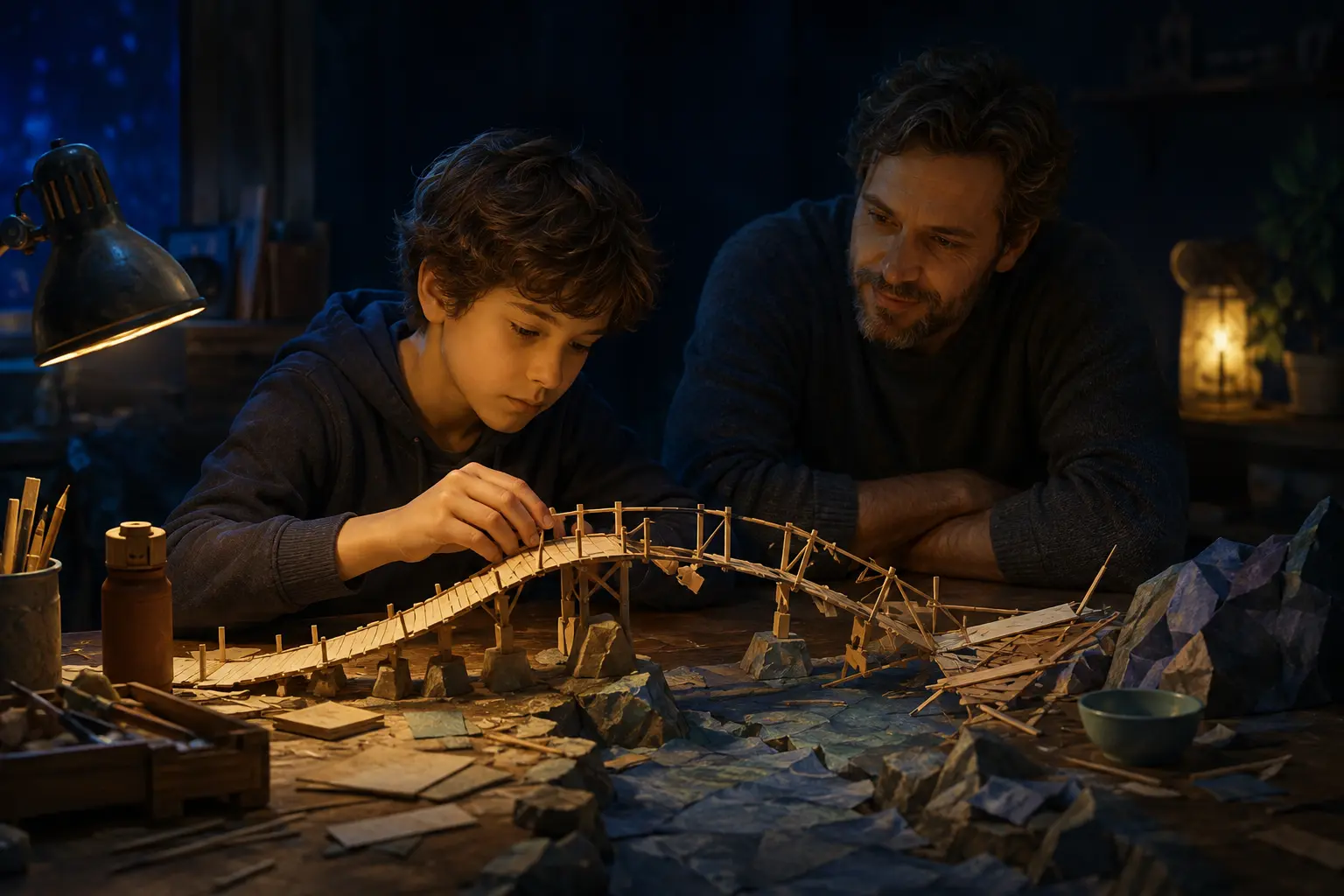
A child brings home a test marked with the teacher's corrections. Misses the ball at a decisive moment. Mixes up words during a performance. Builds a model without following the instructions and now has to start again.
For an adult, this may be a small episode. For a child, a mistake can feel quite different.
“I can't do it.”
“I'm worse than the others.”
“Now they'll laugh at me.”
“I'd better never try again.”
So the question “How can I help a child respond calmly to mistakes?” is not really about mistakes alone. It concerns self-worth, independence, fear of failure and the ability to keep acting when the result is not what was hoped for.
And we should not begin by trying to convince the child that “there is nothing frightening about mistakes”.
If mistakes are already connected with shame, criticism or a sense of being incapable, one correct phrase will not change that.
An attitude towards mistakes develops gradually, from what happens after them.
A child is not afraid of the mistake itself
Imagine two children who solve the same problem incorrectly.
The first notices the error, erases the answer and tries again.
The second closes the notebook and says:
“I'm not doing this.”
The mistake is the same. But the meaning the children give it is different.
For the first it means: “This approach didn't work.”
For the second: “Something is wrong with me. I'm stupid.”
That difference is essential.
When a mistake is seen as information about an action, it can be examined.
When it becomes a description of the child, they want to defend themselves: hide the mistake, argue, blame others, avoid difficult tasks or choose only things where success is almost guaranteed.
A calm attitude to mistakes therefore begins with an important distinction:
doing something wrong does not mean that I am wrong as a person.
“It's nothing” does not always help
When a child is upset, an adult often tries to comfort them quickly:
“Come on, it's a little thing.”
“It's nothing to worry about.”
“You'll manage next time.”
The intention is good, but the child may hear something else: what matters to me right now seems insignificant to the adult.
If they prepared for a competition for several weeks and lost, it may not feel like a “little thing” at all.
Responding calmly to a mistake does not mean feeling nothing.
A child has the right to feel upset, angry, disappointed or ashamed. The adult's task is not to remove those feelings as quickly as possible, but to help the child avoid getting stuck in them or drawing a conclusion about their whole self from one result.
Sometimes it is enough to begin with a simple acknowledgement:
“It looks like you really hoped it would work out.”
Then, when the first emotional wave has passed, you can look at the situation itself.
A mistake should remain a mistake
There is another extreme.
Wanting to support a child, adults sometimes try to convince them that every mistake is wonderful and useful.
But children quickly sense insincerity.
If carelessness means redoing all their work, they are unlikely to welcome such a “wonderful experience”. If their decision hurt another person, “we learn from mistakes” is not enough. Sometimes the consequences really are unpleasant.
In Nine Lessons of Life, we do not suggest celebrating every mistake.
A more useful attitude is:
the mistake has already happened. What can be done with it now?
It can be hidden.
Someone else can be blamed.
The child can decide never to do the activity again.
Or they can look at it as a result that communicates something important about the previous action.
This is the sense in which a mistake becomes part of learning.
Not because it is good.
But because something can be done with it.
The most important moment comes just after a mistake
A child's attitude to their own mistakes is shaped in large part by how important adults respond.
Imagine a child accidentally breaks a cup.
In one case they hear:
“Why do you always drop everything? How can you be so careless?”
The conversation seems to be about the cup, but the message is much broader: the problem is not the particular action, the problem is you.
In another family the response may be different:
“Careful, there are pieces of glass. Let's clean them up first. How did it fall?”
The consequences have not disappeared. The cup is broken and the pieces need clearing up. Perhaps the child really could have been more careful.
But the mistake has not become a verdict on their personality.
This is an important principle: discuss the action rather than defining the person by it.
Not “you are irresponsible”, but “you promised and didn't do it”.
Not “you are careless”, but “you missed two conditions in this problem”.
Not “you always ruin everything”, but “this time it didn't turn out as you expected”.
Then something can change.
Fear of mistakes is often created not by punishment, but by expecting a perfect result
A child does not have to be scolded to begin fearing mistakes.
Sometimes it is enough for adults to notice only the result.
A top mark: well done.
A victory: wonderful.
The best result: parents are proud.
But what happens when the result is ordinary?
If a child feels especially valued when they succeed, a cautious strategy may gradually appear: better not do anything that risks being less than good enough.
A child considered very capable then unexpectedly begins avoiding difficult assignments.
At first that seems strange.
But the logic is understandable: a difficult task threatens the familiar image of “I always get it right”.
It helps to notice more than the final result.
How did the child prepare?
What did they work out independently?
Where did the first attempt fail?
What did they change?
When did they want to give up but continue?
What can they do better now than a week ago?
Value gradually shifts from having to prove success constantly to the ability to develop.
“Pay more attention” almost never explains what to do
After a mistake adults often say:
“Think next time.”
“Pay more attention.”
“You should have prepared better.”
These statements may be formally correct. In practice, the child often does not know how to follow them.
It is far more useful to find a specific point where an action can change.
A child made many mistakes in a test.
Why?
Did they not know the subject?
Did they hurry?
Did they fail to read the whole question?
Did they lose time on the first question?
Were they anxious?
Did they not check their work?
These are different causes, so the next actions will be different too.
If they do not understand the subject, they may need help learning it.
If it is rushing, the child might try leaving a few minutes to check.
If a large test overwhelms them, perhaps they can learn to look quickly through all the questions first.
The mistake stops being abstract proof that “I did badly”.
It becomes a clue to a small change they can make.
Distinguish a mistake from indifference to consequences
There is an important boundary that adults sometimes find hard to draw.
A calm attitude to mistakes does not mean responsibility disappears.
If a child accidentally forgets a notebook, that is one situation.
If they have known about a responsibility for several weeks, deliberately do nothing and then expect adults to fix everything, that is another.
If a child says something hurtful to a friend in a moment of strong emotion, they may have made a mistake.
But that does not remove the need to see how their words affected the other person and, where possible, repair the consequences.
The attitude “it is all right to make mistakes” works only alongside another idea:
you do not have to feel shame for making a mistake, but it is important to be able to do something about it afterwards.
Acknowledge it.
Repair what can be repaired.
Apologise if you hurt someone.
Draw a conclusion.
Change the action.
This is how the freedom to make mistakes connects with responsibility.
Children need to see adults make mistakes
Sometimes parents try to appear to children as people who always know the right thing to do.
We give advice confidently, make decisions and correct children.
But it is extremely useful for a child to see another side of adulthood.
“I was sure I remembered the way, but I was wrong. I'll check the map.”
“I misunderstood you. I'm sorry.”
“I jumped to a conclusion.”
“This approach didn't work. I'll try another.”
The child receives an important example: an adult is not someone who has stopped making mistakes.
An adult is someone able to recognise a mistake, cope with it and keep going.
It is especially powerful when a parent can acknowledge a mistake to the child themselves.
Without losing authority.
On the contrary, the child sees that admitting one was wrong does not destroy a person's dignity.
Sometimes it helps an adult not to rescue
A child leaves some project materials at home, and a parent can rush to bring them.
They misjudge the time, and an adult can finish the work with them at night.
They spend their money and do not have enough for a desired purchase, and the adult can simply add the missing amount.
Each case has its own circumstances. Sometimes helping really is reasonable.
But if an adult constantly removes the consequences of a child's mistakes, a paradox appears.
We tell the child:
“We learn from mistakes.”
At the same time, we do not allow the result of the mistake to occur.
Life never gets the chance to provide feedback.
Small, safe and natural consequences are often more useful than a long conversation.
A forgotten item: the child has to do without it.
Poorly managed pocket money: they have to wait for the next amount.
Delayed preparation: getting everything done in one evening turns out to be difficult.
Of course, this is not about deliberately creating trouble for a child or leaving them alone where the consequences are too serious.
The adult's task is rather this: do not automatically fix everything a child is ready to start learning to fix for themselves.
Mistakes are especially frightening where children are compared
“Look, Anna managed.”
“Everyone else wrote it properly.”
“Your brother could already do that at your age.”
An adult may use comparison to motivate.
But the child often begins to see a mistake not as a relationship between their action and its result, but as a measure of their place among others.
The question then changes.
Not “what didn't work for me?”, but “am I worse than everyone else?”
That is not a very useful focus for learning.
It is much more useful to compare a child with their own earlier experience.
What used to be difficult and is easier now?
Which mistakes have stopped recurring?
What have they learned to notice for themselves?
This creates a sense of movement rather than a constant examination of whether they measure up to others and their expectations.
Not every mistake needs analysing
If every small slip becomes an educational conversation, soon a child may begin avoiding not only mistakes but conversations with parents too.
Sometimes a cup simply falls.
Sometimes an answer in a notebook is simply wrong.
Sometimes a bad day does not require deep analysis.
The ability to learn from life does not mean having to draw a major philosophical conclusion from every event.
Balance matters here.
There are mistakes children correct themselves.
There are situations that need a short question.
There are events worth returning to later.
And there are moments when a child needs support more than analysis.
A calm attitude to mistakes develops partly when the child knows that a mandatory “serious conversation” does not follow every slip.
What to say instead of “Why did you make another mistake?”
The question “why?” is not bad in itself.
But at an emotional moment it can easily sound like an accusation.
Sometimes a conversation is easier to begin differently:
“What happened here?”
“Where did it stop going the way you expected?”
“Did you notice immediately, or only later?”
“What was the hardest part?”
“What do you think could be changed?”
“Would you like to try again, or do you need a break now?”
The point of these questions is not to conduct a perfect educational analysis.
The main thing is to change the child's position.
Instead of a person about to be judged, they become a person exploring their own experience.
Real resilience does not look like an absence of feeling
Sometimes we imagine a child who responds calmly to mistakes as almost unflappable.
They get a poor mark and are not upset.
They lose and shrug.
They are not selected and calmly go home.
But an absence of feelings does not necessarily mean resilience.
If the result really mattered to the child, disappointment is natural.
Resilience appears differently.
This is unpleasant, but I can bear it.
I am upset, but one setback does not define all of me.
I did not manage it, but I can understand why.
I made a mistake, but I can repair some of the consequences.
This approach did not work, but others exist.
This is the kind of inner confidence worth helping a child develop.
The goal is not for a child to stop making mistakes
It is possible to raise a very cautious person who makes almost no visible mistakes.
All it takes is teaching them not to take risks.
Not to voice an uncertain idea.
Not to begin something where they might lose.
Not to disagree.
Not to show initiative.
To choose familiar tasks.
Always to ask an adult first.
There really will be fewer mistakes.
But along with them there may be less independence, creativity and ability to meet the unknown.
The task is therefore not to teach a child to avoid mistakes at any cost.
It is far more important for a sequence gradually to appear:
I tried → got a result → noticed a mistake → understood what I could change → tried again.
Then a mistake takes its normal place.
It is no longer a catastrophe.
But it is not meaningless either.
It becomes one way to gain information about the world, other people and one's own actions.
A child learns an attitude to mistakes alongside us
We can tell children a great deal about the usefulness of mistakes.
But the atmosphere in which they happen is more powerful than words.
Can someone at home say, “I don't know”?
Can they admit, “I made a mistake”?
Can they bring home a poor mark without expecting humiliation?
Can they try something new and not succeed?
Can they change their mind?
After a setback, can we think about another action rather than looking for someone to blame?
And perhaps the most important question for an adult:
what does a child see on my face at the moment they make a mistake?
Disappointment in them?
Irritation?
Fear for their future?
Or the calm confidence of someone who understands that something unpleasant has happened, but it can be worked through?
Repeated moments like these gradually shape a way of thinking that can stay with a child even when the adult is not nearby:
“It didn't work out. Let's see what I can learn from this and what I can do differently.”
Perhaps this is one of the most valuable skills we can give a child.
Not a life without mistakes.
But the ability after a mistake not to lose themselves, to see reality and to continue learning from life.
From reading to experience
Explore a situation together
Talk about what happened, the choices available and what each choice might lead to. It is a chance to think together and hear each other's point of view.
Reflect on your relationship
What is your child learning alongside you?
Explore your everyday responses and discover areas you may want to pay closer attention to.
Explore the parent reflection →Almost finishedWhen you reach the end, this article will be marked as read on this device.
Share this article
Share an idea with other parents
Choose a way to share or copy the link.