
An event becomes a life lesson through reflection: the child separates fact from interpretation, notices their area of influence, compares expectations with the result and chooses what to try differently.
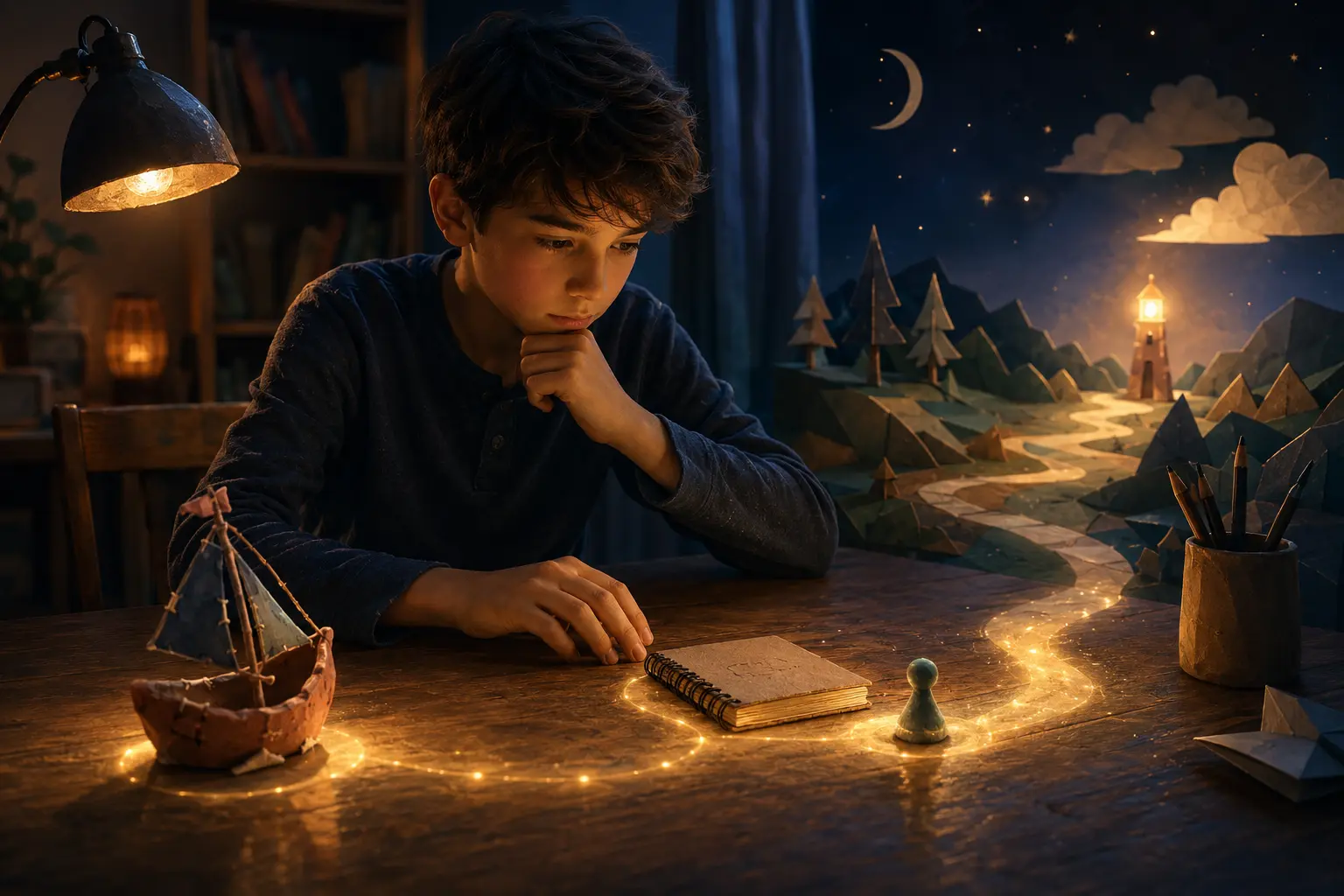
Something happens to a child every day.
They receive a mark they did not expect. Quarrel with a friend. Lose a competition. Lose a favourite possession. Cannot manage a task. Hear criticism. Achieve what they wanted. Agree to something they later regret. Or, conversely, unexpectedly discover they can do something they used to fear.
We call all of this experience.
But there is an important distinction: an event and a life lesson are not the same thing.
We can find ourselves in similar situations many times and act the same way each time. We can experience a setback and take nothing from it. We can encounter the consequences of our decision but decide that only other people are to blame. We can succeed without even noticing which actions led to success.
What happens does not in itself teach us anything.
A life lesson appears when a person begins to understand the connection between what happened, what they did and the result it produced.
This, too, can be learned.
Life constantly gives us material for learning
We usually associate “learning” with a lesson, a textbook, a teacher and a task to complete.
But much of what people actually learn happens quite differently.
One day a child understands that if they put a difficult task off until the last evening, there may not be enough time.
They notice that words spoken in irritation can damage a relationship far more than they expected.
They discover that fear of a performance was harder than the performance itself.
They understand that after rejection or a setback, they can try another way.
Or they notice for the first time that admitting a mistake does not always make them weaker and can sometimes help restore trust.
Nobody wrote this knowledge on a board.
The situation provided it.
But taking part in a situation is not enough for it to become a lesson. We also need to be able to see it.
There is an important pause between an event and experience
Imagine a child is not selected for the school team.
The facts are straightforward: the child wanted to join the team, tried out and was not chosen.
But a very different story may form in the child’s mind almost instantly:
“I'm worse than everyone else.”
“The teacher doesn't like me.”
“Nothing will ever work out for me.”
“I won't even try again.”
This is where the event begins to mix with its interpretation.
That is natural. We all do more than perceive what happens; we immediately try to explain it to ourselves.
But the first explanation is not always the only possible one.
Perhaps the child does not yet have a particular skill.
Perhaps the other participants really were stronger.
Perhaps the selection was subjective.
Perhaps the child needs more time.
Or perhaps, after this situation, they will realise they want to do something else altogether.
If a child can separate “what happened” from “what I thought about it”, even briefly, space opens up for understanding.
And with it comes the opportunity to learn.
The same experience can teach very different things
Two children can live through almost the same event and take different lessons from it.
Both were turned down.
The first decides, “If I was rejected, there is no point trying again.”
The second decides, “I need to understand what I lacked and decide whether I want to try again.”
The same thing happened.
But different experiences took shape.
This is one reason we cannot simply say, “Setbacks make us stronger.”
Not always.
Sometimes a setback really does help a person become more resilient. Sometimes it increases fear. Sometimes it leads to hurt. Sometimes it prompts someone to reconsider a goal. Sometimes it reveals a mistake in their approach.
An event does not contain a ready-made lesson that a child simply has to retrieve.
The lesson emerges through reflection.
So what matters is not only what happened to a child, but also how they learned to understand it.
The first step is to see the event as it was
This is harder than it seems.
If Mira sent a message to a friend and received no reply all evening, that is the fact: the message was sent and there is no reply yet.
“She is deliberately ignoring me” is already an assumption.
“I don't matter to her” is another.
If Max received a low mark, the fact is that he received a particular mark for a particular piece of work.
“I'm stupid” is not a fact.
“The teacher is picking on me” is also, for now, only a possible explanation.
This distinction matters especially because a child often treats their first thought as an accurate description of reality.
When an adult helps clarify what we know for certain and what we are only assuming, they are not dismissing the child's feelings. They are helping the child see the situation more broadly.
Sometimes that alone is enough to make room for a choice instead of an automatic reaction.
Then comes the question: what was within my control?
This is one of the hardest parts of any life lesson.
A great deal of what happens is outside a child's control.
They cannot make another person be friends with them.
They cannot guarantee victory in a competition.
They cannot make everyone around them behave fairly.
They cannot undo an illness, a family move, a change of plans or someone else's decision.
But in almost every situation another area remains: what they can influence.
How to respond.
What to say.
Whether to ask for help.
Whether to keep trying.
Whether to change approach.
Whether to admit a mistake.
How to respond to what has already happened.
The ability to see this boundary protects a child from two extremes.
From believing “everything depends on me”, which leads them to take responsibility even for things they cannot control.
And from believing “nothing depends on me”, which takes away the ability to act.
A life lesson often begins precisely where a child discovers their real area of influence.
Consequences show us where a choice leads
We often understand our decisions only after seeing their results.
A child gets angry and leaves a group project. Several days later they notice the others have continued without them.
They decide not to prepare for a performance because they are sure “it'll work out somehow”, and become flustered in front of the audience.
They decide not to respond immediately to a friend's rudeness, give themselves time to calm down and later manage a different conversation.
They ask for help where they once tried for a long time to hide that they were struggling, and make unexpectedly quick progress.
A consequence is not a punishment life hands out for incorrect behaviour.
It is information.
It shows a person where their chosen action led in a particular set of circumstances.
Sometimes the result confirms the decision.
Sometimes it prompts reconsideration.
Sometimes it is entirely different from what the person expected.
Comparing “what I expected” with “what happened” is what makes experience especially valuable.
But a result is not yet a lesson
Suppose a child decides not to prepare for a test and receives a poor mark.
The conclusion seems obvious: they should have prepared.
But even here there can be different levels of understanding.
We can end the conversation with:
“There, you see? You should have listened to me.”
Then the main lesson may be quite different from what the adult intended: “When I have a problem, Mum starts lecturing me.”
Or we can try to understand more deeply.
Why didn't I prepare?
Was it hard to get started?
Was I sure I could manage anyway?
Did something else distract me?
Did I misjudge how much material there was?
Which of these things can I change before the next test?
Then the child begins to understand not only the result but also the process that led to it.
And that is much more useful knowledge.
Almost every schoolchild already knows the advice “prepare in advance”.
But understanding their own way of putting things off may really change their behaviour.
A life lesson ends not with a conclusion, but with another action
There is another trap.
After an event we can understand everything perfectly and continue acting in exactly the same way.
“Yes, I know I start shouting when I'm angry.”
“Yes, I understand that I put everything off again.”
“Yes, I can see that I agree every time even though I don't really want to.”
Awareness matters, but by itself it does not change life.
A lesson becomes practical when a question appears:
“What will I try doing differently next time?”
Not “what kind of person must I become now?”, but which specific action can be changed.
If I usually respond immediately during a conflict, I can try pausing first.
If a big task frightens me, I can start with a small part.
If I keep forgetting things I agreed to do, I can find a way to write them down.
If I want to give up after the first setback, I can try to understand what caused the result before deciding to stop.
A small change is easier to try out in real life.
Then life provides the next result.
Learning continues in this way.
That is why one lesson sometimes has to be repeated many times
Adults know the feeling:
“We already talked about this. Why are they doing the same thing again?”
Because understanding something once and learning to act in a new way are different processes.
A child may sincerely recognise the consequences of an action and return to their familiar reaction a week later in an emotional situation.
That does not necessarily mean the earlier conversation was useless.
A skill develops through repetition.
At first the child notices what happened only after the event.
Then they begin recognising the familiar situation while it is happening.
In time they may be able to stop before the familiar action.
For example, at first they realise after a quarrel: “I said too much again.”
Later they notice during a conflict: “I'm very angry and I'm starting to say things I might regret.”
Only afterwards does a new possibility appear: “I can feel myself boiling over. I'd better stop now.”
What began as a conclusion after an event gradually becomes a skill used within the event.
The adult’s role is not to draw the conclusion for the child
When an adult understands the reason for what happened, it is tempting to name it immediately.
“You lost because you didn't practise enough.”
“You quarrelled because you don't know how to give way.”
“They didn't listen because you started shouting.”
The adult may even be right.
But another person's conclusion and a child's own discovery work differently.
So sometimes it matters more to help the child explore the situation than to announce its meaning.
What happened?
What did you want?
What did you do?
What result did you expect?
What actually happened?
What do you think influenced that?
What was within your control, and what was not?
Is there anything you would like to try differently next time?
Not every conversation needs all these questions. And certainly they should not be asked in a row, turning every event into a detailed debrief.
Sometimes a child first needs simply to live through the emotions.
Sometimes they are not ready to discuss what happened on the same day at all.
Knowing when to have the conversation is part of parental wisdom too.
Difficulties are not the only things that become lessons
We analyse what went badly far more often.
But success deserves attention too.
A child performed well.
Made peace with a friend.
Managed a difficult task.
Kept going even though nothing worked at first.
Solved a problem independently.
Simply saying “well done” gives a child support, which they need.
But sometimes we can add another question:
“What do you think helped you manage?”
The child begins to notice the strategies that work for them.
I prepared in advance.
I asked for help.
I did not stop after the first mistake.
I managed to calm down.
I broke a difficult task into several parts.
I talked instead of making assumptions about the other person.
These, too, are life lessons.
It matters not only to understand the causes of setbacks, but to know what helps you succeed.
How an event becomes a lesson
Nine Lessons of Life is based on a simple process:
Event → observation → understanding → choice → action → result → reflection.
First, something happens.
Then a person learns to notice the situation without a hasty conclusion.
They try to understand it.
They see what is within their control.
They choose an action.
They receive a result.
Then they return to what happened and ask: what do I know now that I did not notice before?
This is not a strict set of instructions a child must recite each time.
Over time, the process should become a natural way of engaging with life.
It happened.
I noticed.
I thought.
I chose.
I saw the result.
I drew a conclusion.
I tried again.
A life lesson is a change a person carries with them
A real lesson has not happened simply because an adult explained the meaning of a situation to a child.
Nor even because the child could express a conclusion beautifully.
It happens when, in the next similar situation, the child has a few more options than before.
Before, they saw one option; now they see several.
Before, they immediately blamed themselves; now they can distinguish fact from their own judgement.
Before, they stopped trying after rejection; now they can consider whether to try differently.
Before, they noticed consequences only when nothing could be changed; now they begin to see them in advance.
That is learning from life.
Not turning every event into a lecture.
Not searching for a hidden “correct thought”.
And not trying to avoid every unpleasant situation.
But gradually developing the ability to notice connections between ourselves, our decisions and what happens next.
Events will happen regardless.
We cannot choose a life without mistakes, rejection, conflict, change or disappointment for a child.
But we can help them acquire something that will remain useful far longer than any individual piece of advice:
the ability to turn what they live through into experience, and experience into their next, more conscious choice.
From reading to experience
Explore a situation together
Talk about what happened, the choices available and what each choice might lead to. It is a chance to think together and hear each other's point of view.
Reflect on your relationship
What is your child learning alongside you?
Explore your everyday responses and discover areas you may want to pay closer attention to.
Explore the parent reflection →Almost finishedWhen you reach the end, this article will be marked as read on this device.
Share this article
Share an idea with other parents
Choose a way to share or copy the link.