
A mistake shows a difference between expectations and reality. If we do not rush only to correct the answer, a child can understand where their knowledge ended, which assumption was wrong and what to change on the next attempt.
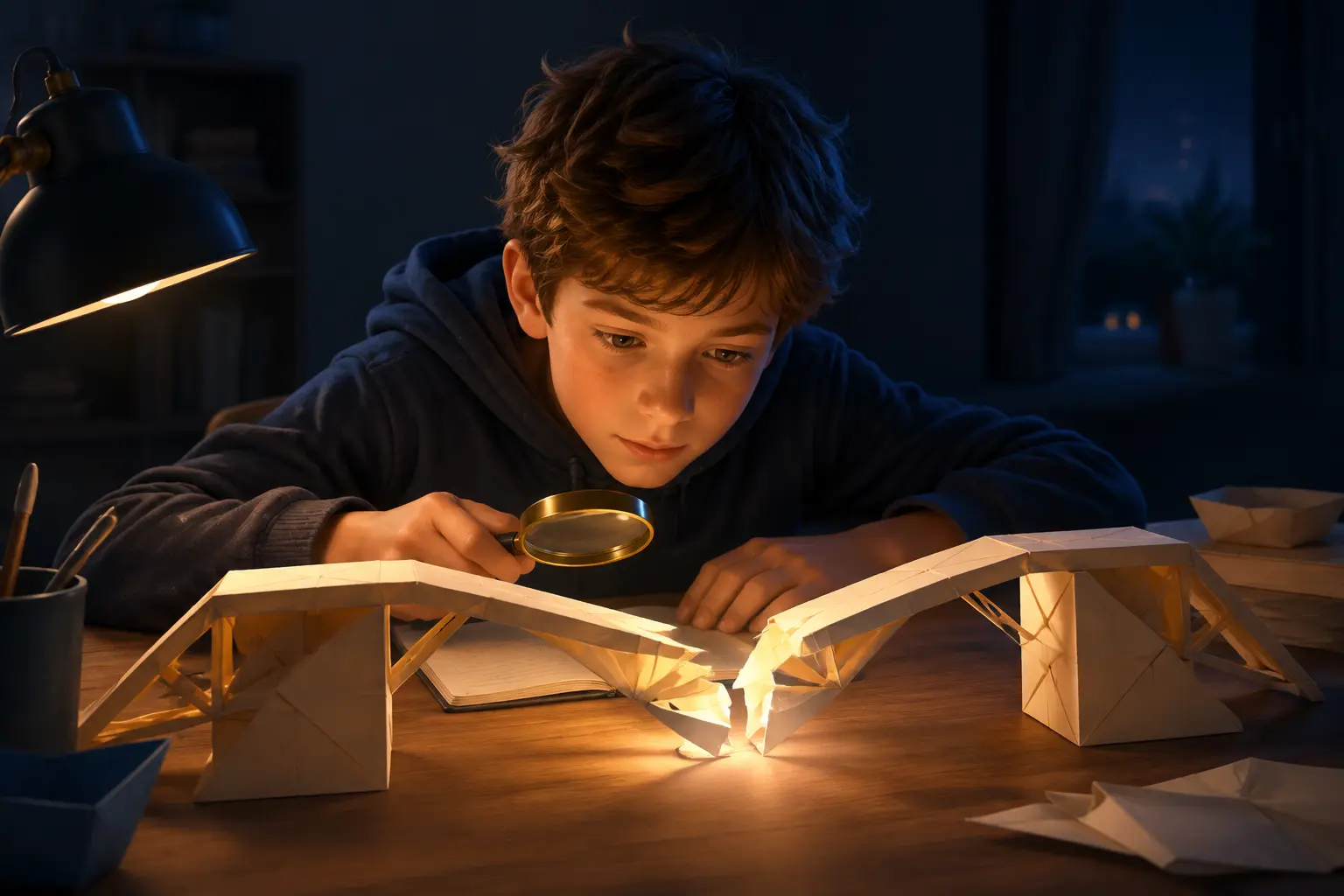
When a child makes a mistake, an adult usually looks at what went wrong.
A wrong answer. An unsuccessful attempt. A broken structure. A lost game. A result different from the one expected.
But a mistake has another side, one we notice much less often.
It shows the difference between what a person expected and what actually happened.
That means it tells them something new.
If a child was sure they understood a topic but could not solve a problem, they learned something about their knowledge that they did not know a minute earlier.
If they devised a way to build a structure and it turned out to be unstable, they received information about their solution.
If they expected a friend to take a joke calmly but the friend was hurt, they discovered that they had predicted the other person's reaction incorrectly.
In this sense, a mistake is less like a red sign saying “the end” and more like a message:
“Your picture of what is happening does not quite match reality. Look more closely.”
That is why a mistake can be an exceptionally valuable source of information.
When everything works, we do not always know why
Imagine a child cooking something on their own for the first time.
They roughly measure the ingredients, put the dish in the oven and get an excellent result.
Success?
Of course.
But do they now know exactly why it worked?
Not necessarily.
Perhaps the temperature was right. Perhaps it was the quantities. Perhaps they were simply a little lucky.
And the next time, the result is quite different.
Now there is a reason to pause and investigate.
What changed?
The temperature?
The proportions?
The time?
The order of actions?
Unexpectedly, a setback makes the child examine the process in much greater detail than success did.
This happens beyond the kitchen too.
While everything works, people often act automatically. Only when the expected result fails to appear do they look inside their own way of acting.
A mistake can therefore sometimes show us more than another successful attempt.
A mistake reveals what we do not yet know
We do not always know where the limits of our understanding lie.
A child may be completely sure they have understood a rule.
They have read the chapter, listened to the explanation and nodded several times. Perhaps they can even repeat the definition.
Then an unfamiliar problem appears, and they cannot solve it.
What happened?
The mistake has shown them where that boundary lies.
I understand this.
But here my understanding is not yet sufficient.
Such a boundary is very useful.
Without it, a child can live with an illusion of knowledge.
That is why a good question after a mistake is not always:
“Why did you get it wrong?”
Sometimes a more interesting question is:
“What did this mistake show you that you had not noticed before?”
The question changes the meaning of what happened.
The child stops seeing the mistake only as a lost mark and begins to see a clue.
Not all mistakes tell us the same thing
If a child spells a word incorrectly, the obvious conclusion seems to be that they do not know the rule.
But that is only one possible reason.
Perhaps they know the rule but were in a hurry.
Perhaps they were tired and missed a letter.
Perhaps they were confident in the wrong version.
Perhaps they know the rule in a familiar example but do not recognise it in a different form.
Perhaps they simply pressed the wrong key by accident.
Outwardly the result is the same: a mistake.
But what it tells us can be entirely different.
Here an important skill appears: not correcting a mistake as quickly as possible, but first understanding what exactly it tells us.
If the reason is a gap in knowledge, the child needs to learn more.
If it is inattention, another explanation of the rule will change nothing.
If it is an unsuitable strategy, simply repeating the same attempt more times is pointless.
That is why “try harder” is often almost useless.
A much more valuable question is:
“Where did things stop working?”
That is already the beginning of a real investigation.
Sometimes a mistake says: your approach no longer works
Some strategies work very well for a time.
For example, in primary school a child quickly memorises material just before class and gets good marks.
They become used to preparing at the last moment.
Several years pass. The material becomes harder and there is more of it.
The old strategy unexpectedly stops working.
The child may conclude:
“I've become worse at learning.”
But the mistake says something quite different:
an approach that once produced results no longer fits the new conditions.
This is an extremely important principle in life.
What led to success once will not necessarily work forever.
Tasks change.
We grow older.
People change.
Circumstances change.
So sometimes a mistake does not require us to “try harder”.
It requires us to change strategy.
For adult life, this is especially important: not clinging to a familiar approach simply because it once produced results.
Sometimes a mistake says: you made an incorrect assumption
We constantly make assumptions about the world, even when we do not notice it.
“I'll have enough time.”
“They'll understand what I meant.”
“I'll have enough money.”
“This task will take ten minutes.”
“If I do this, that will happen.”
As long as the result matches expectations, the assumption remains invisible.
A mistake makes it visible.
A child expected to finish a project in an evening, but it turned out to need three days.
Now they have new information about how accurately they estimate time.
They were sure they could present material to the class without preparation, but became flustered.
They learned something about how much rehearsal they need.
They arranged to meet a friend but did not specify where, because they were sure “it was obvious”.
It turned out that it was not obvious to everyone.
Such mistakes are particularly interesting because they help a child notice their assumptions.
That is already a step towards more mature thinking:
“Why did I expect that particular result?”
A mistake can reveal not only a weak point, but also the limits of control
There are mistakes a person really can correct.
But another situation exists: we made a reasonable choice, prepared well, considered the information available and still got an unwanted result.
That too is part of life.
A child prepared thoroughly for a competition and still did not win.
They worked carefully on a creative project, but the judges chose someone else.
They thought through a proposal for a group project, but the team did not support it.
If every unwanted result is treated as proof of a mistake, a dangerous thought can follow:
“If something didn't end the way I wanted, I must have done something wrong.”
But life is not a machine in which the right action guarantees the desired result.
It involves other people, chance, circumstances and many factors beyond our control.
So investigating a mistake sometimes also means discovering the opposite:
“There really is something I can change in this part of my action. But that part of the result was outside my control.”
That is information too.
Very important information.
It helps a child learn responsibility without turning it into the belief that they control everything.
A mistake can be part of an experiment
In some areas, it is impossible to know the right approach in advance.
Try inventing a completely new game.
Making a first film.
Creating an unusual drawing.
Building a device you have never built before.
Organising a school event.
In such tasks a person is not merely following instructions.
They are exploring the unknown.
Some mistakes are then almost inevitable.
The first version did not fit.
The second was too complicated.
The third partly worked.
The fourth unexpectedly produced an interesting result.
If every attempt is considered a failure, creativity quickly comes to an end.
Very different thinking emerges when a child understands:
“I tried one approach and learned something.”
The next option can now be built without working blindly.
In this sense, experiment and error are closely connected.
A person asks the world a question through action.
The result becomes the answer.
Sometimes the answer is “Yes, this works”.
Sometimes it is “No, look for another way here”.
Both answers increase knowledge.
The least useful mistake is the one we try not to see
Imagine a child who gets a poor result and immediately says:
“The task was stupid.”
Sometimes it really may have been a poor task.
But if every unpleasant consequence is explained only by outside causes, important information disappears.
There is an opposite extreme:
“I do everything badly.”
There is hardly any information here either.
The first reaction says nothing about the person's own participation.
The second applies a label but does not show what actually happened.
So the statements
“Everyone else is to blame”
and
“I'm incapable of anything”
are surprisingly similar.
Both prevent investigation.
Information appears only when we can look more closely.
What did I do?
What did I expect?
What did I get?
Where exactly did the difference appear?
What do I know now?
Accuracy is more useful than blame.
A corrected answer is not always learning
A child makes a mistake in a problem.
The teacher shows the correct answer.
The child copies it.
The mistake disappears from the page.
But has it disappeared from their way of thinking?
Not necessarily.
If the child has not understood why the original reasoning led to the wrong result, a similar mistake can easily return.
So sometimes it is more useful to spend more time on the wrong answer than on the right one.
What was your thinking?
At what point did you decide to do it that way?
What were you relying on?
Where did your reasoning stop matching the conditions of the problem?
This applies far beyond schoolwork.
Not simply “What should you have done?”
But:
“Why did that option seem good to you at the time?”
That is a much deeper question.
The child begins to study not only the event, but also their own thinking.
Some mistakes are better discovered early
Sometimes parents try to protect children as much as possible from wrong decisions.
But as a person grows older, some mistakes become more costly.
Childhood therefore offers a rare opportunity to gain experience where the consequences are still relatively small.
Overestimating how much can be done in a day.
Choosing an awkward way to complete a project.
Managing pocket money poorly.
Organising teamwork unsuccessfully.
Forgetting an important detail.
Each situation can become a small exercise in working with feedback.
Not so a child collects failures.
But so they become accustomed to an important sequence:
I act → the world responds with a result → I adjust my understanding → I act more accurately.
The earlier this process becomes familiar, the less need there is to treat every mistake as an emergency.
What matters is what we do with the information
There is another important point: information is useful only when we use it.
If a child gets the same result ten times, understands the reason and continues acting in exactly the same way, the mistake stops being an investigation.
It becomes repetition.
The phrase “making mistakes is useful” therefore needs a continuation.
What is useful is discovering something new and changing something on the basis of that discovery.
Once the information has been received, the next question is simple:
“What will we do now with what we have learned?”
Sometimes the answer is another attempt.
Sometimes practice.
Sometimes abandoning an approach that does not work.
Sometimes asking for help.
Sometimes deciding not to continue at all because the new information has changed our view of the goal.
That, too, is a normal result of learning.
Children can learn to read their mistakes
We teach children to read text, graphs, maps and instructions.
But a mistake is also a kind of message that needs to be deciphered.
What does it say?
Is knowledge missing?
Was an assumption wrong?
Was there haste?
Was it the strategy?
Did the conditions change?
Was I trying to control something outside my control?
Do I need more practice?
Does the chosen goal itself need reconsidering?
There is no need to ask a child all these questions after every slip.
What matters far more is developing the habit:
not turning away from a result we dislike, but approaching it with curiosity.
That is a very different position towards life.
Not:
“How can I forget as quickly as possible that it didn't work?”
But:
“Interesting. Why did it turn out this way?”
A mistake reduces uncertainty
Before an attempt, there is something a person does not know.
Will this approach work?
Will the preparation be enough?
Will the other person understand me?
Can I do it?
After the attempt there is a result.
Even if it was unwanted, there is a little less uncertainty.
One path has been tested.
One assumption has been clarified.
One boundary has been found.
The person now knows a little more about themselves, the task or the world than before acting.
This is perhaps one of the most underestimated values of a mistake.
It does not necessarily make us stronger.
It does not necessarily lead to success.
It does not have to be pleasant.
But it can make our picture of reality more accurate.
A more accurate picture makes it possible to make the next choice using what we have learned, rather than relying on the same earlier assumptions.
That is why Nine Lessons of Life invites us to see a mistake not as the opposite of success.
It has another function.
A mistake gives us information about how our actions have played out in the real world.
Sometimes the information is unpleasant.
Sometimes unexpected.
Sometimes it requires us to admit that we did not know something or judged the situation incorrectly.
But it is at that point that an opportunity to learn appears.
Not because making mistakes is good.
But because even a result we did not want can answer an important question:
“What do I know now that I did not know before this attempt?”
From reading to experience
Explore a situation together
Talk about what happened, the choices available and what each choice might lead to. It is a chance to think together and hear each other's point of view.
Reflect on your relationship
What is your child learning alongside you?
Explore your everyday responses and discover areas you may want to pay closer attention to.
Explore the parent reflection →Almost finishedWhen you reach the end, this article will be marked as read on this device.
Share this article
Share an idea with other parents
Choose a way to share or copy the link.